
"You have to earn it": Greg Williamson's road back to Seneca County

Leadership Profile
Raised in Bettsville by parents who modeled hard work, the Tiffin City Schools superintendent says experience has taught him to lead calmly, listen carefully and keep students at the center.
By Jimmy Flint
Above: Four generations. Greg Williamson with his father, Roger, his daughter, MacKenzie, and his grandson, who was born in January.
On the rare Sunday afternoons when Greg Williamson's father, Roger, stopped working long enough to turn on an old Western, Greg sat down beside him.
His father, Roger Williamson, drove a truck for more than 30 years, kept busy in his woodshop and later spent 14 years as a school bus driver. Growing up, Williamson rarely saw him sit still. That made those quiet hours in front of the television feel important.
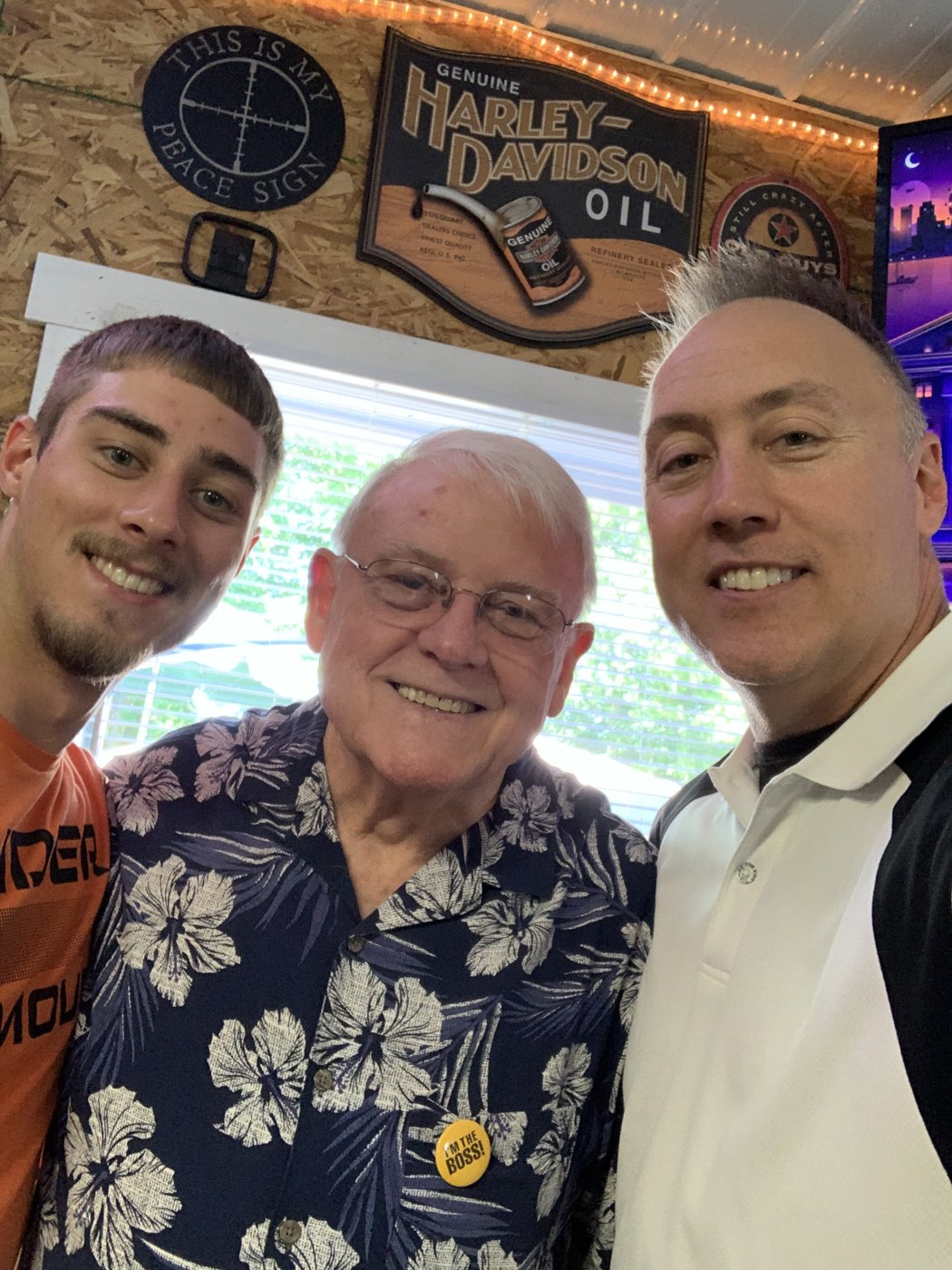
The time together still matters. Today, Roger still lives in Tiffin, and the two spend time together several times each week. Since Williamson's mother, Saundra, died in 2025, those regular visits have become especially meaningful.
It is one of several ways Williamson's new chapter as superintendent of Tiffin City Schools feels less like a departure than a return.
He grew up in Bettsville, the youngest of three children. Saundra went to work as a school cook when he entered kindergarten and spent more than 30 years serving students before retiring. Watching both parents shaped his understanding of effort, responsibility and the difference between what a family or school needs and what would simply be nice to have.
Roger also taught him about trust. During a period serving on the Bettsville school board, he took Williamson to the state basketball tournament and made the rules clear: Whatever the younger Williamson saw or heard among school officials stayed there.
Those trips allowed Williamson to see his school principal differently. The principal played slow-pitch softball with his father, so Williamson knew him as a person, not simply the authority figure behind an office door. He noticed his patience, kindness and sense of humor. Most of all, he noticed that the principal treated people the same.
Decades later, that observation still shapes the way Williamson approaches the superintendent's office.
"I'm not one who feels like I need respect just because of my title. I think you have to earn it."
Greg Williamson
"I'm not one who feels like I need respect just because of my title," Williamson said. "I think you have to earn it."
For Williamson, earning it means showing up, doing the work and being honest. It means helping when he can, admitting when he does not know something and following through when he promises to find an answer.
A career he did not plan
Williamson did not enter college expecting to become an educator. He enrolled at the University of Toledo as a pre-med major, then began questioning whether medicine was truly the life he wanted. A job in a tutoring lab gave him his answer.
"That's when I got bit on education," he said.
He used the science credits he had already earned to become a biology and school health teacher at Old Fort.
While there, Williamson became the student council adviser. The students initially saw student council largely as the group that organized the homecoming dance. That changed when a cafeteria procedure left them frustrated.
Williamson suggested taking the issue to the principal. The students were convinced the principal would not listen because they were kids. Instead of carrying the complaint forward himself, Williamson helped them organize their concerns and request a meeting.
The principal listened and agreed to a change.
"It actually worked," the students told him.
For Williamson, that was the point. Student leadership was about more than planning activities. It was about learning to advocate, participate constructively and discover that a well-made case could be heard.
Williamson became an assistant principal at Glenwood Middle School in Findlay at 28. He later served as principal at McComb High School, returned to Findlay as an assistant principal and became superintendent of Leipsic Local Schools in 2012.
He spent 13 and a half years at Leipsic, the longest stop of his career and an unusually long tenure in the same superintendent's office. Respondents to AASA's 2025-26 Superintendent Salary & Benefits Study reported an average of 5.4 years in their current districts.
Trust tested under pressure
Cindy Erickson watched Williamson lead from the other side of the board table. She served eight years on the Leipsic Board of Education, including in leadership roles and on the personnel committee. She got to know him well, she said, partly because they did not agree all the time.
"He's going to listen to what you have to say and at least think about it," Erickson said. "He doesn't shut you down."
One of the clearest tests came during a Leipsic track project. The district did not have enough money to complete the project alone, and moving it forward depended on the village and other resources. Erickson recalled Williamson serving as the liaison among the school district, village and others involved.
Before difficult conversations, she said, Williamson did the legwork and made sure board members understood every angle, including the "good, bad and ugly" and what could potentially happen.
"We knew we could count on him to take care of it and that he was going to bat for what we wanted and needed," Erickson said. "That was reassuring. We knew he was looking out for the best interest of the district."
Her description of him moves easily between professional and personal: knowledgeable about education policy, highly organized, energetic and fun. The simplest version may also be the most revealing.
"Just a good guy," Erickson said. "Just a good guy to be around, and he has some good energy."

That trust was built over years. Williamson says he learned at Leipsic that what looks like disengagement may be something else entirely. A student staring out a window may not be disrespecting a teacher. That student may be wondering whether there will be food at home or whether someone they love will be safe.
"If we don't get to know kids on a more personal level, they don't care how much you know until they know how much you care," Williamson said.
The belief extends to employees. Whether someone teaches a class, drives a bus, prepares food or maintains a building, he wants each person to understand that the work matters because it touches students. His mother's long career in a school kitchen made that lesson personal long before he became a superintendent.
Knowing how he is wired
For someone who has spent much of his career in public leadership, Williamson is candid about being an introvert.
"I'm a people-oriented introvert," he said.
He enjoys people and has built a career around them, but he recharges internally. Understanding that has helped him recognize that people are motivated differently and that leadership requires learning what brings out the best in someone else.
Williamson also describes faith as a central source of personal grounding. He said he begins each day in prayer, asking for the thoughts, words and actions he needs to serve well. Erickson, who came to know him beyond the boardroom, said that foundation shows through in the way he treats people.
"He leads with humility and grace, and a loving and serving heart," she said.

Family provides another center. Roger and Williamson's two sisters live in Tiffin. His son, Cole, remains connected to Leipsic, and his daughter, MacKenzie Watkins, made him a grandfather in January. Williamson settled in Findlay, placing him close to his grandson and about 30 minutes from both Tiffin and Leipsic.
The road back to Seneca County

As Williamson prepared to close his 13-and-a-half-year chapter at Leipsic, he expected to consider other superintendent opportunities later. Then Erickson called in December. She had heard that Tiffin City Schools needed an interim superintendent and would also be seeking a permanent leader.
The process unfolded in less than two weeks.
Williamson could have stepped away. Instead, Tiffin offered a professional challenge, a return near his roots and an opportunity to keep helping.
"I truly enjoy what I do," Williamson said. "There are certainly bad days and stressful days and tiring days. There are days you go home and realize, 'I got a lot done, but I'm not sure what I got done.' But I still enjoy what I do. I feel confident that I can help."
Erickson said Tiffin gained a leader who had been tested over time.
"You're very blessed to have a leader like Greg in your community and district," she said.
At Tiffin City Schools, Williamson said he found reasons for optimism almost immediately. He pointed to meetings around the district's One Plan, where educators and administrators were examining data and using it to make academic decisions.
He was struck by the quality of the conversations.
"Very professional and very determined to make sure our kids get the best," he said.
Tiffin City Schools Board President Heidi Stephey said Williamson's breadth of knowledge and experience in policy, budgeting and academics gave the Board confidence that he could help move important initiatives and projects forward.
"We also felt that his calm and unassuming demeanor would bring some stability and a sense of calm to the district and our staff," Stephey said. "We have seen this to be true already, even in his time as our interim. His experience and leadership has shown through in his first 90-day action plan. We are into the second 90-day action plan, and he is leading by example."
Calm in the middle
Williamson understands why stability matters. Tiffin City Schools has experienced significant leadership transition, and he believes staff and families need someone who has already lived through the good, bad and difficult parts of leading a school district.
"Through all of my years, it has allowed me to become more stable in how I handle things," he said. "A calm approach to solving problems."
That does not mean the work is calm. Williamson describes the superintendent's job as one that pulls a person in many directions at once. He can arrive with a folder of planned work and never open it because an emergency, unexpected meeting or stream of messages changes the day.
He often returns to a lesson from Stephen Covey's The 7 Habits of Highly Effective People: Put the big rocks into the container first, then allow the smaller rocks and sand to fill the spaces around them. Schools generate plenty of sand, but larger questions about students, employees, academics and finances require sustained attention.
His goal is to hire good people, trust them to do their jobs and create systems that allow him to focus on decisions that truly require the superintendent.
"We still have to determine cost versus benefit while keeping the welfare of the kids front and center."
Greg Williamson
When those decisions involve competing needs, Williamson begins with a cost-benefit analysis rooted in the fiscal caution he learned at home. In a school, however, the calculation can never be purely financial.
"We still have to determine cost versus benefit while keeping the welfare of the kids front and center," he said.
Schools must turn on the lights, heat buildings, fuel buses and maintain property. Many of those costs are outside a district's control. Because much of a school district's spending is tied to people, budget reductions eventually affect the employees who serve students.
The responsibility, Williamson said, is to determine which choices will affect students the least while being honest with employees and taxpayers about the tradeoffs.
A district and its community
Growing up in a small town, Williamson saw the school as one of the centers of community life. On Friday nights, people went to the football game because that was what the community did.
Tiffin is large enough that not everyone's life revolves around the schools, but connected enough that the district and community share a future.
Williamson wants residents to stay informed, understand the district's mission and examine how it is performing. That includes asking whether tax dollars are being used well.
"They owe that to themselves, to know if their tax dollars are going to a good cause or not," he said.
He also hopes those conversations begin with an understanding that educating children is more complicated than it can look from the outside. The district, in turn, must explain its work, acknowledge mistakes and provide the context residents need to judge it fairly.
Williamson's definition of success at Tiffin City Schools begins with two measurable outcomes: a balanced budget and evidence of academic growth each year. It also includes a stronger culture, adults aligned around what students need and more recognition of success when it happens.
He does not promise that every decision will be right. Experience has made him more comfortable acknowledging mistakes, brushing himself off and returning more determined to improve.
His career has brought him back to the place that first taught him what work and leadership look like. Saundra spent more than 30 years serving students from a school kitchen. Roger still lives in Tiffin, where father and son spend time together each week. The standard Williamson learned at home still guides the way he wants to lead.
The title may give him authority. Trust, he believes, still must be earned.
"You do that by showing up and doing the work every day," Williamson said.
◆
Tiffin City Schools
244 South Monroe Street
Tiffin, OH 44883
(419) 447-2515
Contact Us
Follow Us:
If you or someone you know is in crisis, call or text 988 to reach the suicide and Crisis Prevention hotline.
Contact Us
If you are reaching out during non-school hours, your email may not be addressed until the next business day. If you prefer to phone our district office, please call (419) 447-2515.